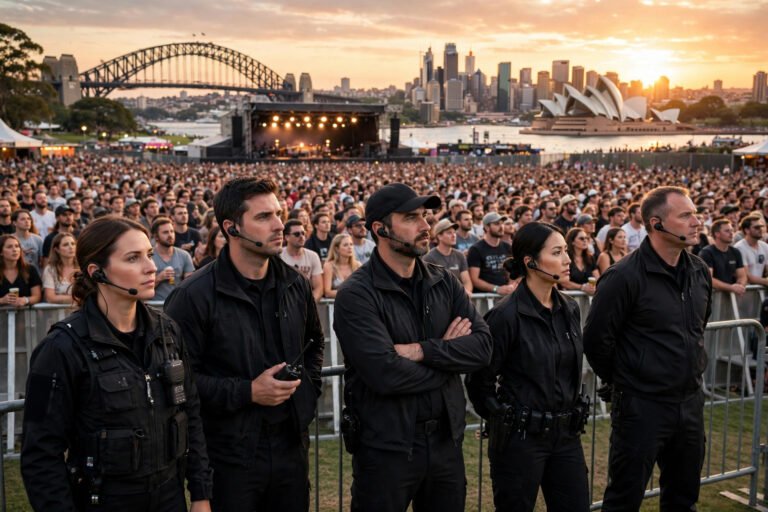

“How many crowd controllers do we need?” is the first question most Sydney event organisers ask — and the honest answer is that the right number depends on far more than the headcount. A seated 300-guest wedding needs a very different team to a 300-person nightclub event with an open bar.
This guide breaks down the ratios the industry actually uses, the factors that push your number up or down, and the NSW licensing rules you can’t ignore.
The Short Answer
As a starting point, the security industry commonly works to a ratio of one crowd controller per 100 guests for low-risk events. But that baseline climbs fast:
- 1 controller per 100 guests — low-risk events: seated dinners, conferences, daytime markets, ceremonies with no alcohol or limited service.
- 1 controller per 75 guests — medium-risk events: standard receptions, corporate parties with an open bar, ticketed shows with general admission.
- 1 controller per 50 guests — higher-risk events: nightclub-style events, festivals, 18th and 21st birthdays with alcohol, events with a history of trouble or known crowd-control issues.
These are industry conventions, not law — your venue, insurer, council, or licensing conditions may set stricter numbers. Always confirm before you book.
Why the Ratio Matters More Than You Think
Understaffing is the most common mistake in event planning. Too few controllers and a single problem — a gatecrasher dispute, an over-intoxicated guest, a medical incident — ties up your entire team while the rest of the venue goes unsupervised. Getting the number right isn’t just about safety; it’s about the event running smoothly enough that nobody notices the security is there.
What Pushes Your Number Up
Start from the baseline and add controllers for each of these that applies:
- Alcohol. The single biggest multiplier. Free-pour bars, drinking games, and late finishes all increase incident rates. Most experienced providers treat open-bar events as at least a 1:75 scenario.
- Young crowd. 18ths and 21sts, school formals, and university events statistically generate more confrontations — factor this into the mix.
- Ticketing vs guest list. Ticketed and open-invite events need door screening; private guest lists with checks at the door need fewer.
- Multiple entry points. Every open door, car park access, and smoking area needs coverage. A venue with three entrances needs more bodies than a single-door hall — count positions, not just people.
- Venue layout. Multi-room venues, mezzanines, outdoor areas, and rooftops split your team. Walk the venue and map positions before you decide on numbers.
- Event history. If the venue or event has had incidents before, add coverage. Insurers and councils certainly will.
- Cash handling. Entry tills, raffle sales, and merchandise stands need watching — assign a dedicated position.
NSW Licensing Rules You Need to Know
In NSW, anyone performing crowd controller duties must hold a valid security licence — specifically the crowd controller subclass on their licence. This is not optional and not a job for “a mate on the door”:
- Licensed, not casual. Crowd controllers must hold a NSW security licence with the appropriate subclass. Using unlicensed personnel exposes you, the organiser, to legal liability.
- RSA coordination. Crowd controllers don’t replace Responsible Service of Alcohol staff — but the two teams must coordinate. A good provider briefs with the venue’s RSA marshal before the event.
- Check the venue’s conditions. Many Sydney venues, especially licensed premises, have development consent or liquor licensing conditions that specify minimum security numbers. These override any ratio in this guide.
- Council and police. Large public events may attract conditions from the local council or police — get the numbers agreed in writing before you advertise the event.
Position Planning: A Worked Example
A 200-guest 21st birthday at a Sydney function venue with an open bar:
- Baseline: 200 guests at 1:75 (open bar) = 3 controllers, rounded up.
- Door: 1 controller on guest list and ID checks at the main entry.
- Floor: 1 controller roaming the reception area and bar.
- Perimeter/outdoors: 1 controller covering the smoking area and car park access.
- Team lead: 1 supervisor coordinating and acting as the point of contact with the organiser.
Total: 4–5 controllers for 200 guests. The common mistake is booking “2 guys for the door” and leaving everything else uncovered.
Booking Tips
- Book 4–8 weeks out for peak season (spring and summer Saturdays book first).
- Brief honestly. Real numbers, real venue details, real crowd expectations. The provider can’t plan what they don’t know.
- Ask about experience with your event type. Wedding security and nightclub crowds are different temperaments — ask what they’ve covered.
- Confirm licensing in writing. Licence numbers should be on the quote, not just a promise.
- Get an itemised quote. Per-guard hourly rates, minimum hours, loadings for evenings and weekends, and any supervisor surcharge — all in writing.
Frequently Asked Questions
How many crowd controllers do I need for 100 guests?
For a low-risk event (seated dinner, no open bar), one to two is a common starting point. For an open-bar party of 100 guests, plan for two — one on the door, one roaming. Always check venue and licensing conditions first.
Is 1 crowd controller per 100 guests a legal requirement?
No — it’s an industry convention, not legislation. Your legal obligations come from the venue’s conditions, your insurer, and any council or police requirements attached to the event. Treat the ratios as a floor, not a ceiling.
Do crowd controllers need a licence in NSW?
Yes. Crowd controllers must hold a valid NSW security licence with the crowd controller subclass. Unlicensed door staff is illegal and leaves the organiser liable.
What’s the difference between a crowd controller and a security guard?
A security guard is the general term for licensed security personnel; a crowd controller is a security officer with the specific NSW licence subclass for managing crowds at events and licensed premises. For public events, book licensed crowd controllers specifically.
Can I use volunteers or mates for crowd control?
No. Beyond the legal requirement for licensed personnel, untrained volunteers have no de-escalation training, no insurance, and no authority to remove trespassers. If something goes wrong, the liability lands on you.
Planning an event in Sydney? Call A4S Security on (02) 4713 1781 for a free event security quote — no obligation, no jargon, just the right crowd control coverage for your guest list.