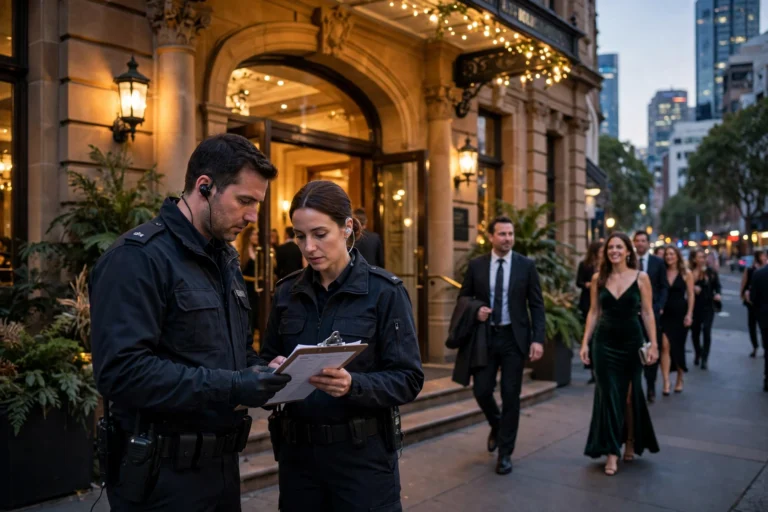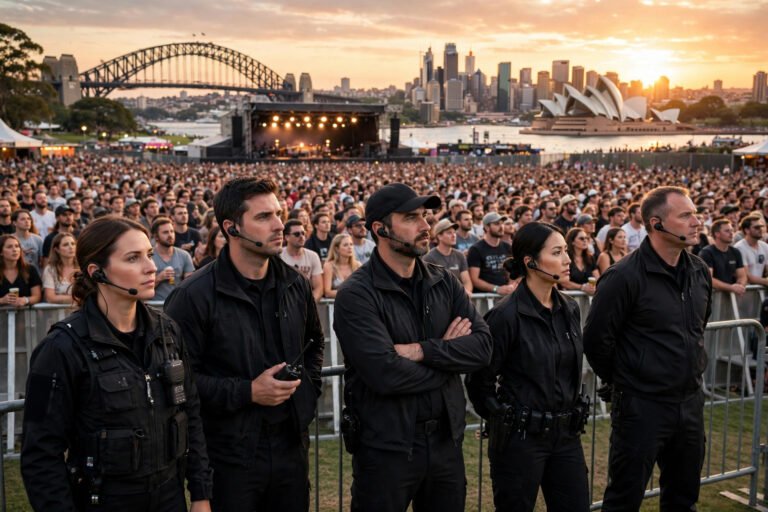

Good event security is invisible. Guests remember the music, the food and the speeches — not the entry lanes, the radio checks or the guard who quietly moved a problem on before it became one. That invisibility isn’t luck. It’s planning: a chain of decisions made weeks before gates open, each one removing a problem from event day.
This guide walks through event security planning the way professional teams actually do it in Australia — from the first risk assessment to the post-event debrief — whether you’re organising a 200-guest wedding, a school fete, a community festival or a 10,000-person concert.
1. Start With a Risk Assessment
Every planning decision flows from one question: what could actually go wrong here? A proper risk assessment looks at:
- The crowd. How many people, what age mix, locals or travellers, families or a young party crowd? A crowd’s profile predicts its behaviour better than its size does.
- Alcohol. Licensed bar, BYO or dry event? Alcohol is the single biggest driver of incidents at Australian events — it changes your staffing numbers, your RSA requirements and your closing-time plan.
- The venue and site. Entry and exit points, fences and natural boundaries, bottlenecks, neighbouring properties, lighting after dark, and where vehicles and pedestrians mix.
- The program. What happens when — headline acts, fireworks, presentations — and where the crowd surges at each point: gates at opening, bars at intervals, exits at closing.
- History. Has this event, venue or crowd had incidents before? What did last year’s debrief say? Repeat problems are the easiest to plan away.
Write it down. Even a one-page risk register — risk, likelihood, impact, what you’ll do about it — turns guesswork into a plan you can brief, insure and defend.
2. Know the Rules: Permits, Licensing & Compliance
Events sit inside a web of Australian rules, and security touches most of them.
- Licensed staff only. In NSW, anyone performing crowd control or guarding work must hold the appropriate security licence, employed through a licensed security firm with a master licence. Unlicensed “helpers in hi-vis” are a compliance breach and an insurance void waiting to happen.
- Council and venue requirements. Many councils require a security plan as part of event approval, and most venues have their own conditions — capacities, curfews, noise limits — that your security plan has to enforce, not just know about.
- RSA obligations. Where alcohol is served, Responsible Service of Alcohol rules apply, and security staff are usually the ones who end up enforcing refusals and removals. Plan for it: who’s authorised, how refusals are handled, and how staff are backed up.
- Insurance and incident reporting. Your insurer will want to see the plan before the event and the incident reports after it. Build the paperwork into the plan, not as an afterthought.
3. Write the Security Plan Document
The risk assessment now becomes a working document: who does what, where, and when. A good plan covers staffing numbers and positions, entry and exit procedures, radio channels and call signs, escalation steps, emergency assembly points, and the exact procedure for the five incidents most likely to occur (medical, intoxication, lost child, gate rush, severe weather).
If you haven’t written one before, our step-by-step guide to creating an event security plan walks through the document itself. The plan should be finished, distributed and briefed at least a week out — not printed in the car park on the day.
4. Staffing: Numbers, Roles & Rosters
Numbers first: there is no single legal ratio for every event, but there are well-established planning benchmarks. As a starting point, most organisers work from how many crowd controllers per 100 guests and adjust up for alcohol, crowd profile and site complexity.
Then define the roles, because headcount alone doesn’t cover a site:
- Gate team. Ticket checks, bag checks, ID and RSA screening at entry — the highest-friction point of the day.
- Roaming patrols. Visible presence inside the event, watching crowd mood, toilets, bars and dark corners.
- Stage / asset guards. Static posts protecting performers, equipment, cash handling and back-of-house areas.
- Supervisor. One experienced lead who owns the radio net, the run sheet and every escalation decision. On the day, this person is the plan.
- Rosters that respect fatigue. Long events need rotations and breaks. A controller in hour eleven of a shift is not the controller you hired.
5. Site Design: Entry, Exit & Crowd Flow
Crowds behave the way the site tells them to. Most crowd problems are design problems discovered too late.
- Separate entry and exit flows, with lanes wide enough for peak arrival — which is always sharper than organisers expect.
- Queue space that doesn’t block footpaths, roads or emergency access. Your queue is part of your site, whether you planned it or not.
- Lighting on every path people will walk after dark — to car parks, toilets, rideshare pickup and the gate.
- A controlled vehicle plan. Deliveries finished before gates, no vehicle movements through crowd areas during the event, and a kept-clear emergency lane at all times.
- Signage that answers questions before they’re asked — entries, exits, toilets, first aid, water. Every confused guest is a small crowd-flow problem.
6. Communications & Incident Response
When something happens, the response is only as good as the information flow.
- One radio net, one channel discipline. All security on one net, plain language, call signs by post not by name.
- A written escalation ladder. What guards handle alone, what goes to the supervisor, what goes straight to police or ambulance — decided in planning, not mid-incident.
- A nominated decision-maker for show-stop calls. Severe weather, crowd crush risk, structural issues: someone must be empowered to pause or evacuate, and everyone must know who it is.
- Lost child and medical procedures rehearsed, with a designated reunite point and a first-aid post that security can direct people to without leaving their own posts uncovered.
7. On the Day: Briefings & the Run Sheet
Planning becomes performance through two habits:
- A pre-event briefing for every staff member — site walk, posts, radio check, the risk register’s top five, and the escalation ladder. Fifteen minutes, no exceptions, including late arrivals.
- A run sheet security actually follows — gates, program peaks, bar close, lights-up, egress. Security positions should move with the program: gates at opening, bars and stage mid-event, exits and car parks at close.
- A log kept in real time. Every incident, refusal, ejection and first-aid call recorded with times. That log is your debrief, your insurance record and next year’s risk assessment.
8. After the Event: Debrief & Improve
Within a week, while memories are fresh: what did the log show, where did queues or tempers build, which posts were over- or under-staffed, and what changes for next time? Events that debrief get safer and cheaper to run every year — the staffing gets sharper, the site design improves, and the plan stops being a document and becomes a system.
When to Call in the Professionals
Plenty of small events run safely on a venue team and a handful of licensed staff. Bring in a professional event security provider early — at planning stage, not the week before — when the crowd is large or young, alcohol is central, the site is complex, the council requires a formal security plan, or the event’s reputation can’t afford a bad night. Experienced crowd controllers and a supervisor who has run your kind of event before will spot risks in your plan that you walk past every day.
Budget honestly, too: security is usually a small line in the event budget and the one that protects all the others. Our breakdown of event security costs in Sydney shows what drives the price and where organisers typically over- and under-spend.
Frequently Asked Questions
How far in advance should I start planning event security?
For most events, four to six weeks out is comfortable: risk assessment, council or venue approvals, staffing and the written plan all take longer than expected. Large festivals and events needing council approval should start three to six months ahead. Small private events can be planned in one to two weeks — but licensed staff book out fast in peak season (October to December in Sydney), so earlier is always safer.
How many security staff does my event need?
It depends on crowd size, alcohol, site layout and crowd profile — there is no single legal ratio for all events. A common planning starting point is around two crowd controllers per 100 guests for licensed, higher-risk events, scaling down for low-risk family events and up for complex sites. Our guide to crowd controller numbers breaks down the benchmarks by event type, and any reputable provider will assess your event and recommend numbers in writing.
Do I need licensed crowd controllers for a private event?
If staff are performing crowd control or guarding duties — checking entry, managing guests, removing people — then in NSW they must be licensed, even at a private party. Venues and councils often require it as a condition of hire, and unlicensed staff can void your insurance if something goes wrong. For small, low-risk gatherings, hosts sometimes manage entry themselves; the moment you hire someone to do security work, they need the licence.
What should an event security plan include?
At minimum: the risk assessment, site map with posts and entry/exit flows, staffing numbers and roles, communications plan (radio net and call signs), escalation and emergency procedures, incident reporting forms, and the run sheet for the day. Many councils and venues have their own template or checklist — ask early, because their format becomes your format.
How much does event security cost in Sydney?
Cost is driven by staff numbers, event duration, day and time (weekends and public holidays cost more), and the risk profile of the event. A small private party might need two guards for five hours; a festival needs teams across a full day plus planning time. The only accurate way to price it is an assessment and a written quote — our event security cost breakdown for Sydney explains the drivers in detail.
Planning an event? Call A4S Security on (02) 4713 1781 for a free event security assessment — no obligation, no jargon, just the right coverage at a fair price.